Testing range-limit theory with replicate evolving flour-beetle landscapes
We use replicate landscapes of flour beetles (Tribolium castaneum) in the lab to test how environmental gradient shape, dispersal magnitude, and within-population genetic variation jointly govern the speed and predictability of range expansion. Whole-genome haplotagging across hundreds of beetles lets us watch the genomics of expansion in real time — including how standing variation, drift, and gene surfing shape the leading edge.
With Topher Weiss-Lehman (Wyoming). Supported by NSF DEB #2230806.
Key publications
Increasing temporal variance leads to stable species range limits
John W Benning, Ruth A Hufbauer, and Christopher Weiss-Lehman
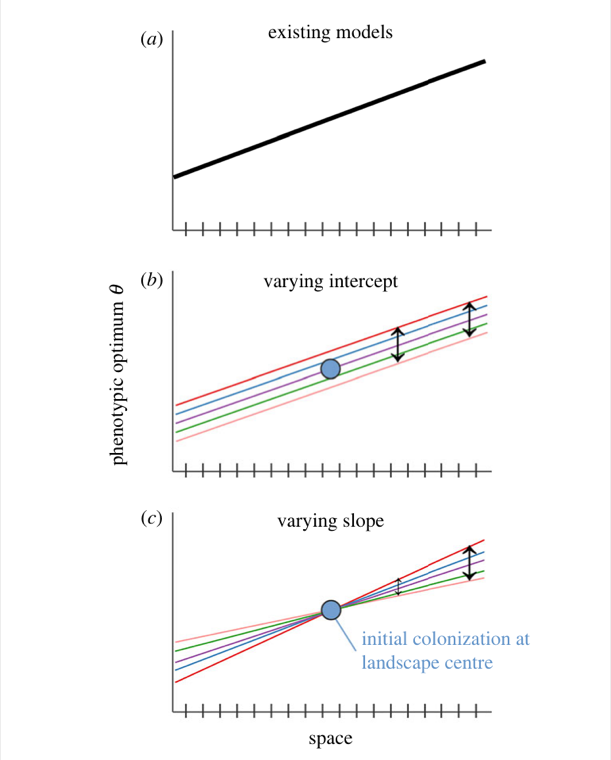
What prevents populations of a species from adapting to the novel environments outside the species’ geographic distribution? Previous models highlighted how gene flow across spatial environmental gradients determines species expansion versus extinction and the location of species range limits. However, space is only one of two axes of environmental variation - environments also vary in time, and we know temporal environmental variation has important consequences for population demography and evolution. We used analytical and individual-based evolutionary models to explore how temporal variation in environmental conditions influences the spread of populations across a spatial environmental gradient. We find that temporal variation greatly alters our predictions for range dynamics compared to temporally static environments. When temporal variance is equal across the landscape, the fate of species (expansion versus extinction) is determined by the interaction between the degree of temporal autocorrelation in environmental fluctuations and the steepness of the spatial environmental gradient. When the magnitude of temporal variance changes across the landscape, stable range limits form where this variance increases maladaptation sufficiently to prevent local persistence. These results illustrate the pivotal influence of temporal variation on the likelihood of populations colonizing novel habitats and the location of species range limits.
Environmental gradients mediate dispersal evolution during biological invasions
John W Benning, Eliza I Clark, Ruth A Hufbauer, and Christopher Weiss-Lehman
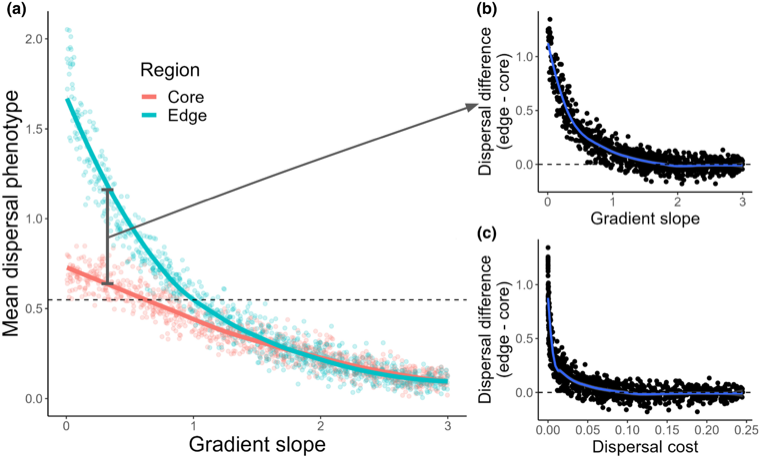
Rapid evolution of increased dispersal at the edge of a range expansion can accelerate invasions. However, populations expanding across environmental gradients often face challenging environments that reduce fitness of dispersing individuals. We used an eco-evolutionary model to explore how environmental gradients influence dispersal evolution and, in turn, modulate the speed and predictability of invasion. Environmental gradients opposed evolution of increased dispersal during invasion, even leading to evolution of reduced dispersal along steeper gradients. Counterintuitively, reduced dispersal could allow for faster expansion by minimizing maladaptive gene flow and facilitating adaptation. While dispersal evolution across homogenous landscapes increased both the mean and variance of expansion speed, these increases were greatly dampened by environmental gradients. We illustrate our model’s potential application to prediction and management of invasions by parameterizing it with data from a recent invertebrate range expansion. Overall, we find that environmental gradients strongly modulate the effect of dispersal evolution on invasion trajectories.